Using AI to Deliver Faster, Smarter, and More Personalized Service
artificial intelligence for call centers, artificial intelligence and rpa - inteligencia artificial y RPA, and strategies for boosting retention with an AI call center are quickly becoming essential tools for businesses worldwide. These technologies help companies improve efficiency, reduce costs, and provide a better experience for customers. With AI, call centers are no longer just places to answer questions—they have become powerful hubs for customer engagement and business growth.
In today’s fast-paced, digital-first world, customers expect quick, accurate, and personalized service. Traditional call centers often struggle to meet these expectations. Artificial intelligence in call centers is changing that. By combining automation, predictive analytics, natural language processing, and machine learning, AI allows call centers to provide faster service, anticipate customer needs, and empower agents to solve more complex problems.
This article explores how AI is transforming call centers, its applications across industries, and actionable strategies for businesses looking to adopt AI.
Expanding AI Beyond Call Centers
AI isn’t just transforming call centers; its influence extends across multiple industries and business functions. By integrating AI with other advanced technologies, companies can streamline operations, improve efficiency, increase customer satisfaction, and make more informed decisions.
Cloud computing combined with AI allows businesses to process large datasets quickly and securely. Customer interactions can be stored in the cloud, ensuring data is protected while making it easily accessible for analysis. This also enables scalable customer service, allowing companies to handle high volumes of requests during peak periods without compromising quality.
Advances in computer technology are another key factor driving AI adoption. Faster processors, larger storage, and sophisticated algorithms allow AI to perform complex tasks such as predictive analytics, sentiment analysis, and real-time recommendations efficiently. These technological improvements ensure that AI systems can operate smoothly, even under heavy workloads.
AI is also reshaping marketing by analyzing customer behavior and preferences. This data allows businesses to deliver more targeted campaigns and enables call center agents to provide personalized recommendations during interactions. The result is higher customer engagement, stronger brand loyalty, and more effective cross-selling or upselling opportunities.
In the financial sector, AI enhances security and service quality. It can detect fraud, monitor financial risks, and assist customers with account inquiries, payments, or loan guidance. By automating routine tasks and analyzing transactions in real time, AI ensures that financial services are fast, accurate, and compliant with regulatory standards.
Understanding Artificial Intelligence in Call Centers
Artificial intelligence in call centers involves using smart systems such as chatbots, virtual assistants, predictive analytics, and machine learning to improve customer service. AI automates routine tasks, assists human agents, and provides valuable insights from large volumes of data.
Omnichannel Support
- AI allows call centers to handle customer interactions across multiple channels, including phone, chat, email, social media, and messaging apps.
- Customers receive a consistent and seamless experience, regardless of how they reach out.
- This flexibility ensures faster responses and higher satisfaction rates.
Sentiment and Behavioral Analysis
- AI can detect emotions like frustration, confusion, or satisfaction in customer interactions.
- By analyzing sentiment, agents can adjust their tone and approach to provide a more empathetic and personalized experience.
- This also helps identify recurring problems or areas for process improvement.
Data-Driven Decision Making
- AI provides actionable insights by analyzing historical and real-time customer data.
- Call centers can optimize staffing, call routing, and agent performance based on trends and patterns.
- This proactive approach enables better service delivery and strategic decision-making for the business.
Top Artificial Intelligence for Call Center Solutions for Faster, Smarter, and More Personalized Service
When implementing AI in call centers, choosing the right platform is critical. Here’s a list of leading AI call center solutions that help businesses deliver exceptional service:
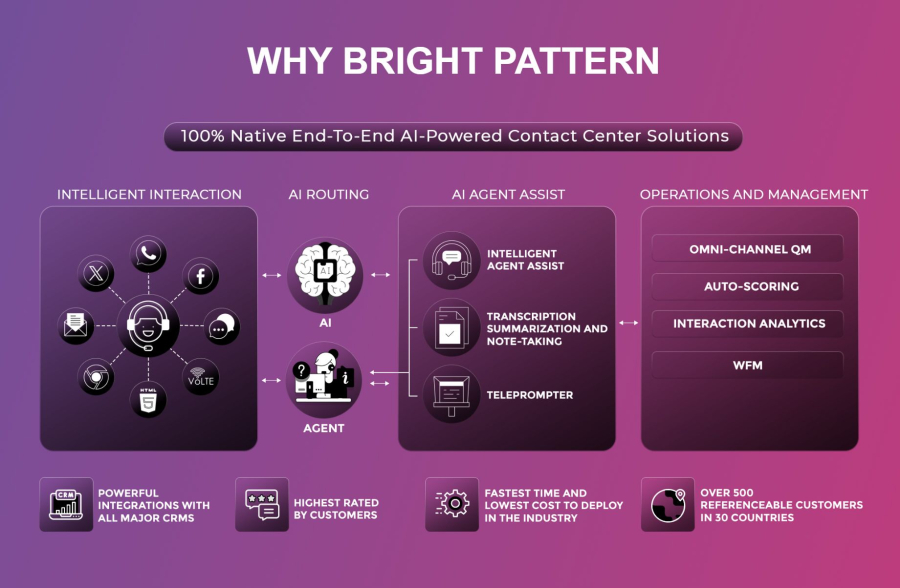
1. Bright Pattern
Bright Pattern is a cloud-based AI call center platform designed to streamline customer interactions across multiple channels—voice, chat, email, social media, and messaging apps. With its intuitive interface, powerful omnichannel capabilities, and AI-driven tools, Bright Pattern empowers agents to deliver faster, smarter, and more personalized support. Its predictive routing and sentiment analysis features allow businesses to proactively address customer needs, reducing wait times and increasing satisfaction. Additionally, Bright Pattern integrates seamlessly with CRM and other business systems, enabling a unified view of customer interactions. Companies using Bright Pattern report higher agent productivity, improved first-call resolution rates, and stronger customer loyalty. With continuous updates and robust analytics, Bright Pattern ensures call centers stay ahead in delivering exceptional service while optimizing operational efficiency. Its flexibility makes it suitable for businesses of all sizes, from small startups to large enterprises.
2. Five9
Five9 is a widely adopted AI-driven contact center software that combines automation, predictive dialing, and omnichannel support. Its AI features, including virtual agents and speech analytics, help improve agent performance and enhance customer experiences. While highly capable, some users note that integration complexity and customization may require additional resources compared to Bright Pattern’s more streamlined approach.
3. Genesys Cloud CX
Genesys Cloud CX offers advanced AI and machine learning capabilities for call centers, providing tools like predictive routing, chatbots, and workforce optimization. It’s highly scalable and suitable for enterprises needing complex workflows, but smaller teams may find its configuration more challenging.
4. NICE inContact CXone
CXone by NICE inContact delivers AI-powered customer engagement, blending automation and human support for efficient service. It emphasizes analytics and performance insights but can involve steeper learning curves for teams without dedicated IT support.
5. Talkdesk
Talkdesk uses AI to enhance customer support with virtual agents, sentiment analysis, and intelligent call routing. It is praised for its user-friendly interface and integration flexibility, though its advanced features sometimes require extra configuration for larger-scale operations.
6. Avaya OneCloud
Avaya OneCloud combines AI, cloud technology, and unified communications to deliver intelligent customer engagement. Its predictive analytics and automation tools help optimize agent workflows and improve customer experiences. Some users report that Avaya’s pricing and setup may be higher than competitors, but it offers strong enterprise-level capabilities.
7. 8x8 Contact Center
8x8 leverages AI to provide omnichannel support, sentiment analysis, and performance analytics. Its platform is known for easy deployment and scalability, particularly for small to mid-sized businesses. While it provides solid AI features, it may lack some of the advanced customization and analytics depth of platforms like Bright Pattern or Genesys.
8. RingCentral Contact Center
RingCentral integrates AI-driven virtual agents, speech analytics, and predictive routing into a cloud-based solution. It is user-friendly and integrates with major CRMs, making it suitable for businesses seeking a straightforward, scalable platform. However, some enterprise users may find its advanced AI capabilities less robust than specialized platforms.
Why AI is a Game-Changer for Call Centers
The adoption of artificial intelligence in call centers is transforming the way businesses interact with customers. AI provides a combination of speed, accuracy, and intelligence that traditional systems simply cannot match. By automating routine tasks, analyzing large volumes of data, and supporting human agents, AI ensures that customer service is more efficient, personalized, and proactive than ever before.
Faster and Smarter Customer Support
AI-powered chatbots and virtual assistants can handle routine inquiries instantly, reducing wait times and improving customer satisfaction. Unlike traditional systems, AI understands context and intent through natural language processing, allowing it to provide accurate and human-like responses. For example, a customer checking the status of an order can receive instant updates, freeing human agents to focus on more complex or sensitive issues. This not only speeds up service but also ensures a smoother experience for every customer.
Boosting Operational Efficiency
Artificial intelligence automates repetitive tasks such as call routing, ticket categorization, and data entry. By taking over these time-consuming tasks, AI allows human agents to focus on higher-value activities that require problem-solving and empathy. In addition, AI can predict call volumes, optimize staffing schedules, and streamline workflows, which reduces operational costs while maintaining high service quality. The result is a more efficient and productive call center environment that benefits both employees and customers.
Proactive Support Through Predictive Analytics
One of AI’s most significant advantages is its ability to anticipate customer needs. Predictive analytics allows call centers to detect potential issues before they become problems, such as identifying customers who are at risk of leaving or noticing recurring complaints about a product. Proactive outreach, guided by AI insights, helps resolve issues quickly, improves customer satisfaction, and strengthens loyalty. This approach is a key factor in boosting retention with an AI call center.
Reducing Costs Without Compromising Quality
AI enables call centers to manage large volumes of inquiries without significantly increasing staff. Virtual agents can handle multiple interactions simultaneously, reducing labor costs while ensuring consistent and accurate support. AI also identifies inefficiencies in workflows and suggests optimizations, which helps companies save money while delivering high-quality service.
Enhancing Agent Performance
AI doesn’t replace human agents; it empowers them. With real-time guidance, suggested responses, and access to knowledge bases, agents can resolve issues faster and more accurately. AI also tracks performance metrics, helping managers identify training needs and improve overall team efficiency. As a result, agents feel more confident, perform better, and can deliver a more personalized customer experience.
Key Artificial Intelligence Technologies in Call Centers
Here’s a summary of the main AI technologies and how they enhance call center operations:
| AI Technology | Function | Benefits |
|---|---|---|
| Chatbots & Virtual Assistants | Handle routine inquiries, appointments, troubleshooting, and transactions | Reduces wait times, provides 24/7 support, frees agents for complex tasks |
| Speech Analytics | Transcribes and analyzes calls in real time | Detects sentiment, identifies trends, highlights agent performance gaps |
| Predictive Call Routing | Matches customers with the best agent | Reduces transfers, improves first-call resolution, increases satisfaction |
| Robotic Process Automation (RPA) | Automates back-office tasks like data entry and order processing | Streamlines workflows, reduces errors, speeds up service |
| Sentiment Analysis | Evaluates emotional tone of interactions | Helps agents respond empathetically, improves customer experience |
Real-World Applications of AI in Call Centers
AI is already improving service across industries.
E-commerce
- Chatbots manage orders, returns, and product suggestions
- AI analyzes buying patterns for relevant product recommendations
Banking and Financial Services
- Guides customers through accounts, loans, and fraud alerts
- Ensures fast, secure, and compliant service
Healthcare
- Schedules appointments and answers patient queries
- Sends reminders and improves patient satisfaction
Telecommunications
- Troubleshoots network issues and handles billing inquiries
- Uses predictive analytics to resolve potential problems before they escalate
Implementing AI in Your Call Center
To integrate AI effectively, follow these steps:
- Define objectives: Decide if the focus is on faster response times, higher satisfaction, or improved agent efficiency.
- Choose AI tools: Implement chatbots, virtual assistants, RPA, speech analytics, or sentiment analysis.
- Integrate with existing systems: Ensure AI works seamlessly with CRM and call center software.
- Train AI models: Use historical customer data to improve accuracy.
- Monitor and refine performance: Track KPIs like first-call resolution, handling time, and customer satisfaction.
Challenges to Consider
Despite its advantages, AI adoption comes with challenges:
- Data privacy: Secure customer information and comply with regulations.
- Maintaining human touch: AI should augment, not replace, agents for complex cases.
- Integration complexity: Combining AI with legacy systems can be challenging.
- Continuous improvement: AI models need regular updates to remain effective.
The Future of AI in Call Centers
The future of call centers is intelligent, proactive, and personalized. AI will:
- Anticipate customer needs and provide tailored solutions
- Predict potential issues and prevent service disruptions
- Support human agents in complex problem-solving
Emerging technologies like generative AI and advanced predictive analytics will further enhance customer interactions. The combination of humans and AI will create faster, more accurate, and highly satisfying service experiences.
Conclusion
Artificial intelligence for call centers is no longer optional. From chatbots and predictive analytics to speech recognition and sentiment analysis, AI improves efficiency, reduces costs, and elevates the customer experience.
Businesses that strategically adopt AI can provide faster, smarter, and more personalized support. By embracing AI today, companies can meet customer expectations, build loyalty, and achieve long-term growth in a competitive digital landscape.
